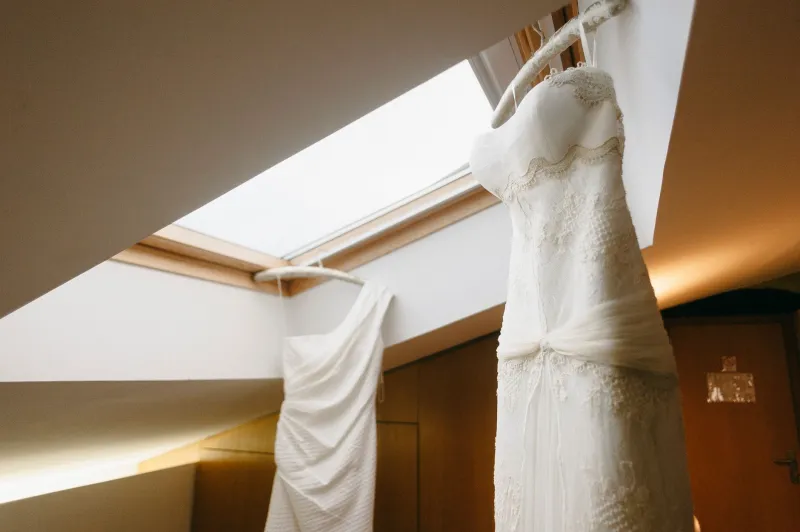
Woven in Reverence: The Fabrics and Embellishments That Give Formal Wear Its Sacred Presence
Step inside any chapel — whether a modest country church in rural Virginia or a soaring cathedral in Chicago — and something happens to the body before the mind has time to process it. The light shifts. The air feels different. The scale of the space, the filtered glow through stained glass, the cool solidity of stone underfoot — these elements conspire to produce a sensation that is almost physical in its weight. Reverence, it turns out, is not purely emotional. It is sensory.
The finest formal wear operates by the same principle. A gown that carries genuine spiritual presence does not announce itself loudly. It arrives quietly, the way morning light enters a sanctuary — and once it does, it changes the atmosphere of every room it inhabits. The question, then, is not simply what looks beautiful. It is what feels sacred.
At Kay's Chapel Boutique, this distinction shapes every conversation we have with our clients about textile selection. Fabric is not merely the medium of a gown. It is its first language.
Silk and the Theology of Light
No textile has a longer association with ceremony and solemnity than silk. Across cultures and centuries — from the silk vestments of the Catholic liturgical tradition to the elaborate ceremonial robes of East Asian royal courts — this fiber has been understood as something apart from ordinary cloth. Its luminosity is the reason. Silk does not simply reflect light; it interacts with it, creating a surface that appears to shift and breathe as the wearer moves.
For bridal and formal wear, silk charmeuse and silk satin offer the most immediate sense of this quality. Charmeuse, with its fluid drape and subtle sheen, catches light in the manner of candlelight on water — softly, without glare, with a warmth that feels almost alive. Silk satin, by contrast, is more deliberate in its brilliance. It carries the confidence of a polished altar surface, commanding attention through stillness rather than movement.
For clients who find pure silk's delicacy a practical concern, high-quality duchess satin — a heavier, structured weave — provides similar luminosity with considerably more body. This is the fabric of gowns that stand on their own, that hold their shape through a long reception or a late evening ceremony, that look as composed in a photograph taken at midnight as they did at noon.
The Architecture of Taffeta and Organza
If silk speaks the language of light, taffeta speaks the language of structure — and structure, in formal wear as in sacred architecture, communicates permanence.
Chapels are not built to feel temporary. Their weight is intentional. The thickness of their walls, the height of their ceilings, the deliberate placement of every arch and column — all of it serves to say: this moment matters enough to be held by something that will endure. Taffeta carries this same message. Its crisp, slightly stiff hand creates volume that does not collapse, silhouettes that hold their geometry through hours of wear. A ballgown skirt in silk taffeta does not merely exist — it occupies a room, the way a great pipe organ fills a nave with sound.
Organza occupies the opposite end of the structural spectrum, and yet it achieves something equally architectural. Layered over a structured underskirt or used to construct voluminous sleeves, organza creates the visual sensation of stained glass — translucent, ethereal, holding light without quite capturing it. When embroidered or embellished, it becomes something closer to a mosaic: intricate, devotional, painstaking in its construction.
Embellishment as Illuminated Manuscript
The medieval tradition of the illuminated manuscript understood that some subjects demanded more than plain text. Gold leaf, hand-ground pigments, hours of labor applied to a single page — these were acts of devotion as much as craft. Certain embellishments in formal wear carry the same spirit.
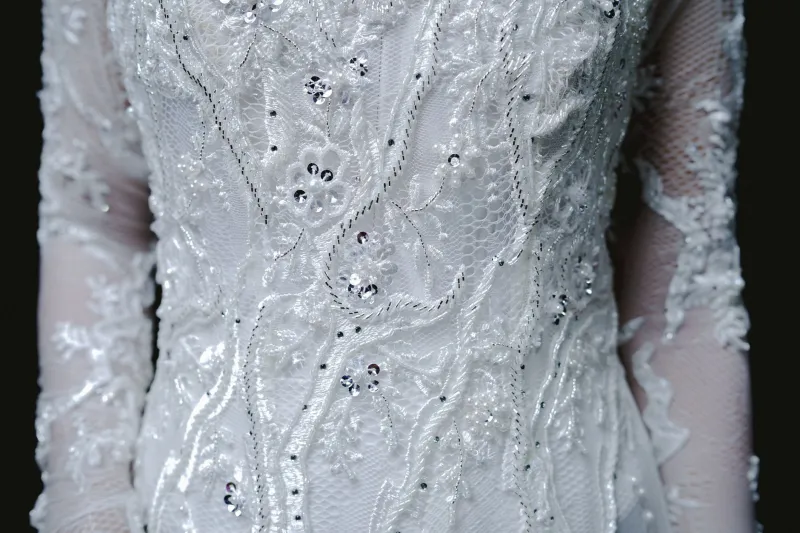
Hand-sewn beadwork, particularly when executed in seed pearls or crystal, creates a surface that functions much like the decorative metalwork found on liturgical objects. Each bead is a single decision made by a skilled artisan. The cumulative effect is one of extraordinary intentionality — a garment that communicates, without words, that the person wearing it was considered worthy of extraordinary care.
Lace, too, carries deep ceremonial resonance in American bridal culture. Chantilly lace, with its delicate floral motifs and fine ground, evokes the lacy ironwork of historic Southern churches. Alencon lace — heavier, more precise, its motifs outlined in a corded thread — has the quality of a relief sculpture: dimensional, authoritative, timeless. At Kay's Chapel Boutique, we often recommend Alencon for clients who want their gown to feel genuinely heirloom in quality, something that could, with proper care, outlast the occasion for which it was made.
Construction as Devotion
Perhaps the most overlooked dimension of sacred formal wear is what cannot be seen at all. The interior construction of a truly exceptional gown — its boning, its underlining, its hand-finished seams — is the equivalent of a chapel's foundation. No one admires it directly. But everyone feels its presence.
A gown that is properly boned and underlined holds its wearer in a way that feels, quite literally, supportive — as though the garment itself is participating in the occasion. French seams, flat-felled seams, and hand-whipped hems are not merely technical choices. They are expressions of a maker's conviction that the inside of a garment matters as much as its exterior, that care applied where no one will look is still care that counts.
This philosophy is central to how we approach made-to-order and custom work at Kay's Chapel Boutique. The construction of a gown is its moral argument — its proof that the wearer deserved to be clothed with intention, from the first internal seam to the last exterior stitch.
Choosing with Intention
When a client arrives at our boutique uncertain of where to begin, we often ask a simple question: How do you want to feel when you walk into the room? The answer almost always points toward a fabric.
For those who want to feel luminous and fluid, we begin with silk. For those who want to feel grounded and strong, we explore structured taffeta or duchess satin. For those who want to feel as though they are carrying something larger than themselves — a family history, a spiritual conviction, a sense of profound occasion — we turn to lace, to beadwork, to the embellishments that require patience and skill to execute.
Sacred presence in formal wear is not a matter of price alone, nor of label, nor of trend. It is a matter of alignment between the person, the occasion, and the materials chosen to honor both. At Kay's Chapel Boutique, that alignment is the work we consider most meaningful — and most worthy of the name we carry.