Stone, Light, and Silk: How Your Venue's Architecture Should Shape the Gown You Choose
There is a moment, standing alone inside the space where you will exchange vows or mark a life-changing occasion, when the room speaks to you. The quality of the light through the windows, the rhythm of the columns, the texture of the walls — all of it carries an emotional frequency that no mood board or magazine spread can fully replicate. At Kay's Chapel Boutique, we have long believed that the most harmonious formal looks are not simply chosen; they are discovered in dialogue with the spaces that hold them.
The relationship between architecture and attire is one of the most underexplored dimensions of bridal and formal styling. Yet it is, in many ways, the most intuitive. A gown that might feel overwhelmingly grand in a minimalist loft becomes an act of poetry inside a centuries-old stone chapel. A sleek, column-cut dress that reads as cold in a baroque interior transforms into something quietly revolutionary against a wall of plate glass and pale wood. Understanding this dynamic is not about following rules — it is about deepening the conversation between who you are and where you stand.
The Gothic Chapel: When Architecture Calls for Drama
Few settings command the imagination quite like a gothic or neo-gothic chapel. Found across the American Northeast and Midwest — in university campuses, historic urban neighborhoods, and countryside estates — these spaces are defined by their verticality. Pointed arches draw the eye relentlessly upward. Ribbed vaulting creates a sense of celestial geometry overhead. Stained glass casts moving pools of jewel-toned light across stone floors.
In these environments, a gown must be willing to rise to the occasion without competing with it. Cathedral-length trains are not mere tradition here — they are a visual echo of the architecture's own sense of procession and depth. Ball gowns with structured, layered skirts honor the drama of the space while grounding the wearer within it. Fabrics that interact beautifully with light — duchess satin, silk taffeta, heavily embroidered lace — come alive under the chromatic wash of stained glass in ways that matte fabrics simply cannot.
Necklines in gothic-inspired settings often benefit from a degree of ceremony. A portrait neckline, a long-sleeved illusion bodice, or even a high-collared design echoes the architectural formality without sacrificing femininity. The key is to let the space inform your scale: where the ceiling soars, your silhouette may do the same.
The Modern Sanctuary: Embracing Restraint as Its Own Eloquence
Contemporary chapels and event spaces — those glass-and-concrete structures that have proliferated across American cities and resort landscapes over the past two decades — operate on an entirely different visual logic. Here, the architecture speaks through subtraction. Clean lines, abundant natural light, and the deliberate absence of ornament create a setting where the wearer, rather than the room, becomes the primary visual statement.
In these spaces, a heavily embellished gown can read as visual noise rather than beauty. Instead, consider silhouettes that honor the architecture's own philosophy: a minimalist crepe column gown, a sleek A-line with a single structural detail, or a bias-cut design that moves with organic ease. The power of a modern sanctuary lies in how it frames simplicity as something sacred, and your attire should be willing to meet that invitation.
Fabric choice becomes especially important in contemporary settings. Silk charmeuse, stretch crepe, and matte mikado all carry an inherent quietude that complements spare interiors. Where the space provides light as its primary decorative element, choose fabrics that accept and diffuse that light rather than reflecting it aggressively.
The Rustic Chapel and Garden Sanctuary: Nature as Co-Designer
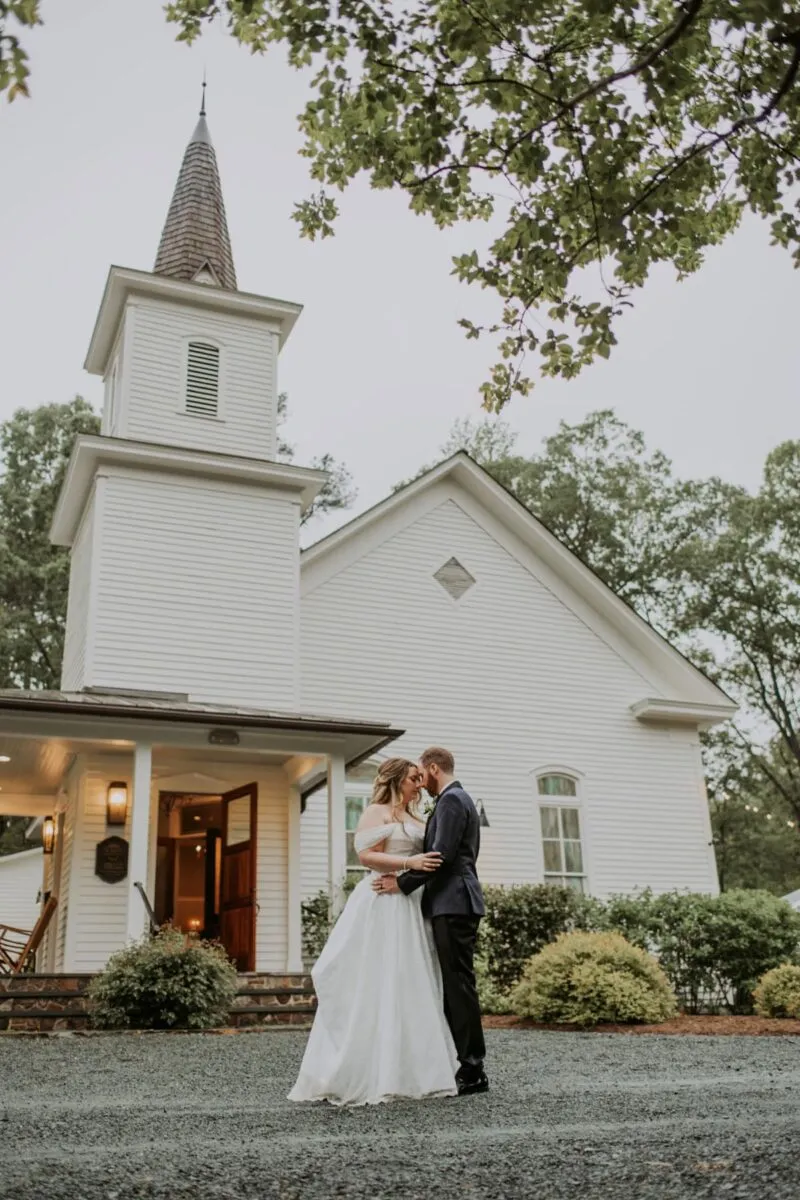
Across the American South, the Pacific Northwest, and New England's rural landscapes, barn chapels, garden pavilions, and converted farmhouse sanctuaries have become deeply beloved settings for intimate celebrations. These spaces are defined by their organic textures — raw wood, fieldstone, climbing wisteria, and the unpredictable beauty of the natural world pressing in from every side.
In these environments, the most resonant gowns tend to be those that feel grown rather than constructed. Soft, flowing fabrics such as silk chiffon, organza, and delicate lace carry an ease that harmonizes with natural surroundings. Botanical embroidery, floral appliqué, and textural detailing that mimics organic forms — leaves, branches, water — create a visual continuity between the wearer and the setting.
Silhouettes in rustic or garden settings benefit from movement. A gown that drifts and shifts with a gentle breeze becomes part of the landscape rather than a contrast to it. Consider styles that allow for ease of movement, whether a fluid A-line, a tiered skirt, or a romantic cape overlay that catches the wind.
The Historic Estate Chapel: Honoring Lineage Without Imitation
Many American families celebrate their most significant moments in historic estate chapels — private family properties, preserved plantation houses, or grand historic venues that carry the weight of generations. These spaces are rich with visual history: ornate woodwork, aged oil paintings, candlelit sconces, and the particular gravity that only time can confer.
Dressing for a historic setting is an act of both respect and reimagination. The goal is never costume — it is conversation. A gown that draws from the vocabulary of the space without replicating its period can feel both timeless and deeply personal. Think structured bodices with period-inspired detailing, long sleeves rendered in contemporary lace, or a silhouette that references the past while remaining unmistakably modern.
The color palette of a historic interior — aged ivory, candlelight gold, deep burgundy, forest green — can also inform your gown's tonal choices. A dress in warm ivory rather than bright white will settle into a historic chapel with a sense of belonging rather than contrast.
Listening Before You Look
At Kay's Chapel Boutique, our styling consultations often begin not with fabric swatches or silhouette sketches, but with a question: Tell me about the space where this moment will happen. The answers our clients give — the way their voices change when they describe a childhood church or a vineyard chapel they visited at sunset — tell us everything we need to know about where to begin.
Your gown and your venue are not separate decisions. They are a single, unfolding expression of the moment you are stepping into. When you allow the architecture around you to speak, you give yourself permission to choose something that does not merely look beautiful in a photograph — it feels inevitable in the room where it was always meant to be worn.