Dressed in Living Color: Why Today's Brides Are Rewriting the Palette of the Formal Aisle
For well over a century, the white wedding gown has functioned as something close to cultural law in the United States — a visual shorthand for tradition, purity, and the solemnity of the occasion. And yet, quietly and with increasing confidence, American brides are beginning to question whether white is truly the color that speaks their story. The answers they are arriving at are as varied and luminous as the women themselves.
At Kay's Chapel Boutique, we have observed this shift not as a trend in the fleeting, seasonal sense, but as something more enduring: a genuine broadening of the formal bridal imagination. Brides today are arriving at their styling consultations with mood boards saturated in champagne, blush, soft sage, warm ivory, and occasionally something more daring — a deep burgundy, a dusty lavender, a burnished gold that catches the light like a cathedral window at midday.
What is driving these choices? And how does a bride find the non-white palette that feels not merely fashionable, but authentically, spiritually right?
The Loosening of a Long Tradition
It is worth noting that white's dominance in American bridal fashion is, historically speaking, relatively recent. Queen Victoria's 1840 white gown popularized the convention in Western culture, but for centuries before — and in many cultures still today — brides dressed in the full spectrum of human color. Red for luck and prosperity in Chinese and South Asian traditions. Gold for abundance. Deep jewel tones for regality and celebration.
The contemporary return to color, then, is less a departure from tradition than a recovery of a far older and more diverse one. Many brides who choose non-white gowns describe the decision as a form of cultural reclamation — an honoring of heritage that white's hegemony had quietly obscured.
Others arrive at color through a more personal lens. A second marriage, a vow renewal, a milestone birthday celebration — occasions that carry their own emotional weight and call for a palette that reflects lived experience rather than a convention designed for a different chapter of life.
The Shades That Are Reshaping the Aisle
Certain colors have emerged as particular favorites among clients exploring non-white formal options.
Champagne and warm ivory remain the most accessible entry point for brides who want to depart from stark white without straying far from tradition's comfort. These tones photograph beautifully, suit a wide range of skin tones, and carry a vintage warmth that feels romantic without sacrificing formality. For brides drawn to chapel settings, the way champagne silk reflects candlelight is nothing short of extraordinary.
Blush and dusty rose have sustained their appeal for years now, and with good reason. These shades occupy a luminous middle ground between femininity and sophistication, reading as romantic in intimate settings and genuinely striking in grander venues. Paired with the right embellishment — perhaps a delicate crystal beading or a whisper of French lace — a blush gown achieves an almost otherworldly quality.
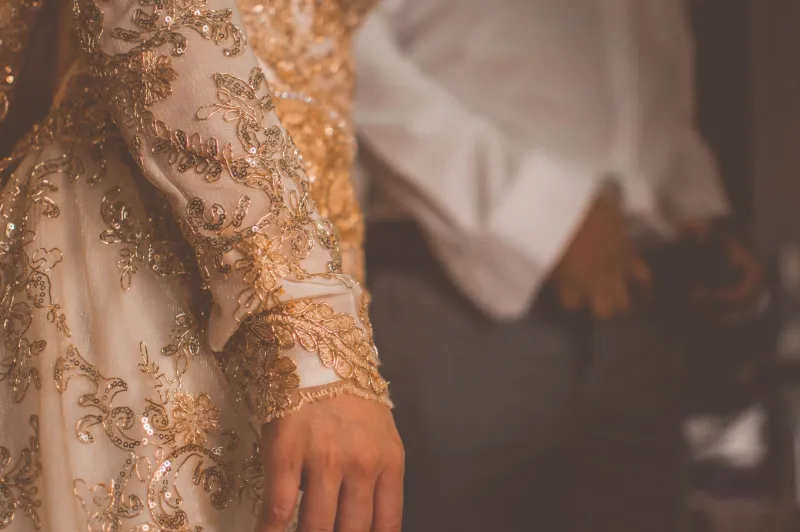
Soft gold and antique bronze are the choices of brides who want their gown to make a statement rooted in warmth rather than volume. These tones carry an inherent richness that reads as celebratory without being theatrical. They are, in the most literal sense, the colors of sacred spaces — of gilded altars and illuminated manuscripts and the last light of an October afternoon through stained glass.
Jewel tones — deep sapphire, forest emerald, wine-dark burgundy — represent the boldest end of the spectrum and are chosen by women who have no desire to be subtle about their joy. These are formal wear choices made with full conviction, and they command a room in the most magnificent way. A bride in midnight blue velvet is not asking for permission. She is making a declaration.
Cultural, Personal, and Practical Considerations
Choosing a non-white gown is not a decision made in a vacuum. Several intersecting factors shape the choice, and understanding them can help guide a bride toward her most authentic answer.
Skin tone and undertone matter enormously when selecting color. Cool-toned complexions tend to be elevated by colors with blue or violet undertones — think dusty mauve, icy champagne, or deep jewel tones. Warm-toned complexions glow in the presence of golden, peachy, or earthy hues. A skilled boutique stylist can help identify undertones and map them against fabric swatches in natural and artificial light, both of which will be present on a wedding day.
Venue and season also exert significant influence. A blush gown that feels perfect in the soft light of a spring garden ceremony might read differently against the stone walls of a historic chapel in November. Consider how your chosen setting's light, texture, and color palette will interact with your gown. The most successful non-white choices are those that feel continuous with their environment rather than in conflict with it.
Family and cultural expectations deserve honest consideration, though they need not be determinative. Open conversations with family members about the significance of your color choice — particularly when that choice carries cultural meaning — can transform potential tension into genuine connection. Many brides find that explaining the why behind their palette opens doors to understanding that assumption had kept closed.
Finding the Color That Is Yours
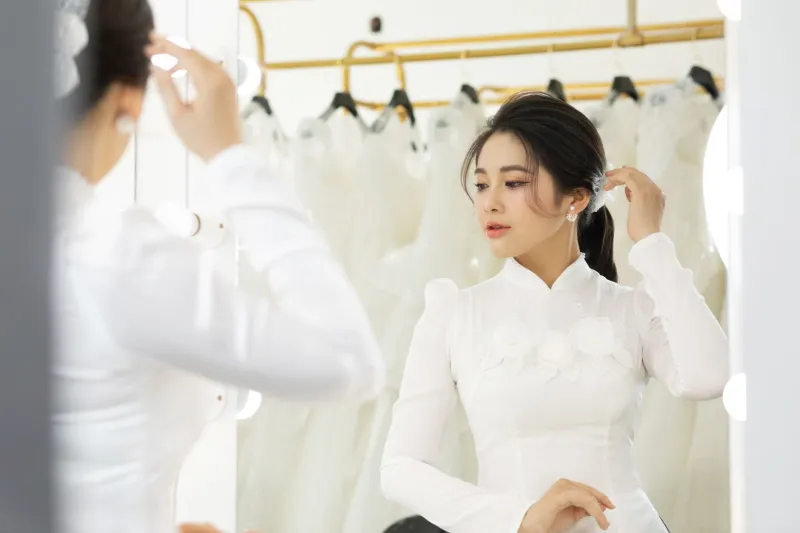
The most important question to ask when exploring non-white formal wear is not "what is popular" or even "what is flattering." It is: what color, when I stand before the mirror wearing it, makes me feel most fully myself?
This is a question that deserves time and space to answer. At Kay's Chapel Boutique, we encourage clients to approach color exploration with the same reverence they bring to silhouette and fabric — as a genuine act of self-knowledge rather than a process of elimination.
Bring swatches home. Hold them in the light of the room where you begin your mornings. Consider how the color makes you feel when you are alone with it, without the influence of anyone else's reaction. The gown you wear on your most sacred occasions should be chosen in that quality of quiet — and the color, above all, should feel like a truth you are finally allowing yourself to wear.