Built to Be Beautiful: The Hidden Engineering That Makes a Gown Feel Like a Second Skin
When a woman steps into a gown that fits her perfectly — one that holds her exactly where she needs holding and releases her exactly where she needs freedom — she often describes the sensation in almost spiritual terms. She stands differently. She breathes differently. The room feels different. What she is experiencing, though she may not name it this way, is the result of extraordinary structural engineering working invisibly on her behalf.
At Kay's Chapel Boutique, we speak often about the sacred nature of formal dressing. But sacredness, in our understanding, is not merely aesthetic. It is architectural. It is built into the bones of a gown long before the outer fabric is cut, long before a single embellishment is placed. It begins in the decisions that no one will ever see — and that is precisely what makes those decisions so important.
What We Mean by Understructure
The term understructure refers to the internal support systems built into a formal garment — the components that give it shape, stability, and the capacity to move gracefully with the human body rather than against it. These elements include boning, structured seaming, corsetry-style panels, interfacing, built-in bras or cups, horsehair hem tape, and layers of lining and underlining that each serve a distinct mechanical purpose.
In mass-produced formal wear, these elements are frequently minimized or eliminated entirely in the interest of lowering production costs. The result is a garment that may photograph beautifully but performs poorly in real life — slipping, shifting, compressing the body in unflattering ways, or requiring constant adjustment throughout the evening.
In a made-to-order boutique gown, understructure is not an afterthought. It is the foundation upon which everything else is built.
Boning: The Quiet Architecture of Posture
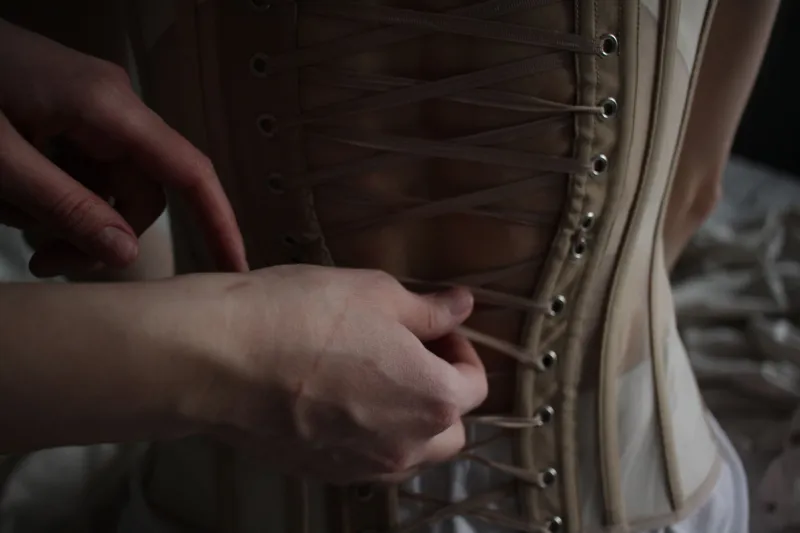
Boning — the insertion of rigid or semi-rigid channels into a bodice — is one of the oldest and most misunderstood elements of formal wear construction. Many women approach the idea of a boned bodice with apprehension, associating it with discomfort or restriction. When done poorly, that association is entirely warranted. When done with skill and intention, boning is transformative.
The purpose of properly placed boning is not to constrain the body but to support it. A well-boned bodice distributes the weight of a structured gown across a wide surface area, relieving pressure from the shoulders and preventing the fabric from collapsing or pulling. It encourages an upright posture not through force but through gentle, consistent support — the way a well-designed chair encourages you to sit well without demanding it.
At Kay's Chapel Boutique, our made-to-order process allows us to place boning precisely where each individual client's body needs it most. No two women's torsos are identical, and no two boning configurations should be either. This level of customization is simply not possible in ready-to-wear formal wear, regardless of price point.
Seaming as Sculpture
The seams of a formal gown are not merely the lines where pieces of fabric are joined. In the hands of a skilled pattern maker and seamstress, seam placement is a sculptural tool — one that creates curves, defines the waist, lifts and supports the bust, and shapes the hip without the use of any external support.
Princess seaming, for example — a construction technique that runs vertical seams from the shoulder or armhole through the bust and down to the hem — can create extraordinary definition and shaping using only the precise manipulation of fabric grain and tension. A gown constructed with thoughtful seam architecture can make a woman appear taller, more defined, and more graceful, not because it is hiding anything but because it is working in harmony with the natural geometry of her body.
This is one of the reasons why the fitting process at Kay's Chapel Boutique involves multiple appointments rather than a single session. Seam adjustments made across several fittings allow us to refine the sculptural conversation between the garment and the wearer until the result is as close to perfect as craftsmanship allows.
Support Systems That Liberate Rather Than Limit
One of the most common concerns our clients express when choosing formal wear is the question of support — particularly for the bust. In a gown that must work without the assistance of a traditional undergarment, the internal support system becomes critically important. A gown that does not provide adequate support is not simply uncomfortable; it is a source of anxiety that can distract a woman from being fully present in her own moment.
Built-in cups, underwire channels, and structured lining panels can, when properly executed, provide support that rivals — and often surpasses — that of a conventional bra, while remaining entirely invisible and eliminating the need for external undergarments that might create visible lines or require uncomfortable adjustment. The key is that these systems must be constructed to the specific measurements and proportions of the individual wearer. A generic cup size inserted into a standard bodice is not support. It is an approximation.
At Kay's Chapel, we take precise measurements and consider the full three-dimensional architecture of each client's body before designing the support structure of her gown. The goal is always the same: to create a garment in which she can move freely, breathe fully, and focus entirely on the experience she is dressed for.
Hem and Lining: The Finishing of the Foundation
The understructure of a gown does not end at the waist. The hem and lining of a formal piece play equally important structural roles. Horsehair braid — a stiff ribbon sewn into the hem of a full skirt — gives a gown the capacity to hold its shape and sweep gracefully without requiring excessive weight in the fabric itself. A properly weighted hem prevents a skirt from clinging, collapsing, or tangling around the legs during movement.
Lining, meanwhile, serves multiple purposes simultaneously. It protects the outer fabric from contact with the skin, prevents transparency, adds a layer of modesty and coverage, and — when cut and sewn correctly — provides an additional layer of shaping that works in concert with the outer seams to create a more refined silhouette.
These are not glamorous details. They are, in many ways, the least visible aspects of a gown's construction. But they are the details that separate a gown that feels extraordinary from one that merely looks it.
Why Structure Is Sacred
At Kay's Chapel Boutique, we use the word sacred deliberately and often. We believe that formal dressing — at its best — is an act of reverence: for the occasion, for the community gathered, and above all, for the woman at the center of the moment.
Structure, in this context, is not a technical concern separate from the spiritual one. It is the physical expression of that reverence. When we build a gown that holds you beautifully, moves with you effortlessly, and supports you without your awareness of being supported, we are honoring your body as the extraordinary and unique architecture it is.
That is not engineering. That is devotion.